Practical model selection
Select in evidence lanes, not one universal rank.
The Epoch catalog can narrow models by job, domain, access, release, and weights. The current Arena table adds one preference signal. Your own evaluation makes the deployment decision.
Reusable report graphic
Evidence-first model selection workflow
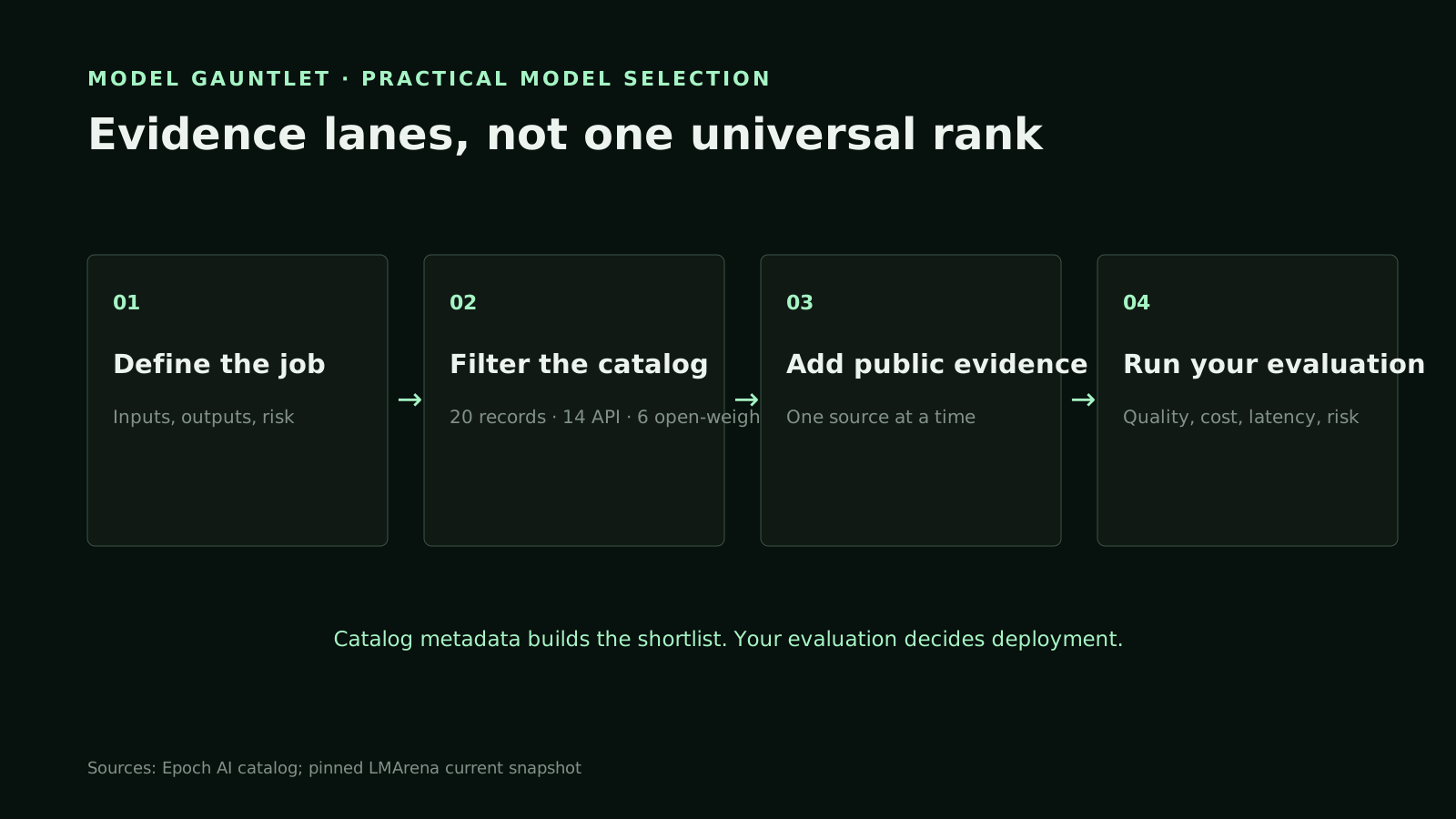
The graphic follows this report's evidence boundaries and may be cited with a link to this page.
Finding 01
1. Translate the workflow into requirements
Write down the actual input, output, error cost, review path, languages, modalities, volume, and security constraints before opening a leaderboard.
The current reviewed catalog contains 456 records and exposes task and domain labels. Use those labels as discovery metadata, not proof that a model meets your quality threshold.
Filter the model catalogFinding 02
2. Choose an operating path
The catalog currently records 118 API-access entries and 140 entries marked open weights. Those groups imply different hosting, governance, licensing, and maintenance work.
Open weights do not automatically mean unrestricted use, and API access does not establish price, availability in every region, or acceptable data terms. Read the exact access label and source.
Compare two to four modelsFinding 03
3. Add public performance evidence carefully
The current LMArena snapshot ranks one frontier entry per provider for text style-control overall. Its leader is Claude Fable 5 at 1507.5, but that table does not measure every task or operating constraint.
Keep confidence intervals and battle counts beside point estimates. Do not blend catalog facts and Arena Score into an unsupported composite.
Review the sourced standingsFinding 04
4. Run the evaluation that matters
Build a fixed test set from representative work and known failure cases. Score correctness, format adherence, refusal behavior, citation quality where needed, latency, retries, and human-review burden.
Measure the full system, including prompts, tools, retrieval, caching, fallback behavior, monitoring, migration, and governance. Record the model version and date so the decision can be reproduced.
- Shortlist by task and domain.
- Filter by access and licensing needs.
- Use public rankings as one signal.
- Test representative and adversarial cases.
- Price the full workflow.
- Set a re-evaluation trigger.
Evidence boundary
What this report does not claim.
- The Epoch catalog does not provide normalized price, context-window, latency, reliability, safety, or private-task quality measurements.
- Task and domain labels describe catalog metadata, not benchmark wins.
- The current Arena table covers one explicitly labeled preference-evaluation scope.
- No universal winner or composite score is published.
See the methodology and corrections policy.
Report source ledger
2 pinned artifacts support this report.
| Date | SHA-256 | Artifact |
|---|---|---|
| 2026-07-21 | 80ad08198183693101ceb246a5ea272d64c06c147fc41f72cca8526b32483424 | Open source |
| 2026-07-16 | ff3ab58a356705bf358638573bbb92f0482fb082a33ca477d8b7962a98deacc8 | Open source |